Stories Made Tangible: Angkor Wat
About this blog series
As we all know, narratives do not have to be confined to speech or the written word. They are ingrained in humanity, in all conceivable aspects of our existence, shaping the way we think, process and translate information. Though something as simple as recounting what happened to you earlier today to a friend or anyone who cares enough to listen already constitutes storytelling, it is always more fun and exciting to be creative and explore other forms of expression.
Personally, my favourite is when narrative takes on a physical medium: something with a body and ambience, something you can see, touch, and even walk through e.g. time capsule rooms in museums; ancient cultural sites; commemorative buildings. Falling the category of narrative architecture, these are examples of stories coming to life in the space around you, immersing you in a transformed environment.
You can find a plethora of lists on this topic by looking it up, compiled by experts with examples more compelling and cohesive than mine, but since this is my blog, I’m just going to share spaces I’ve been to or have taken an interest in. This way, I can share stories of my own, too. Every visit is an activation between site and visitor, you see.
When I started making my list of places for the series, I predicted that religious or spiritual architecture would easily take up half the list and well, it did. The first three narrative experiences that are theological in nature, two of which I’ve personally encountered. We’ll start with Angkor Wat in Cambodia.
Angkor Wat
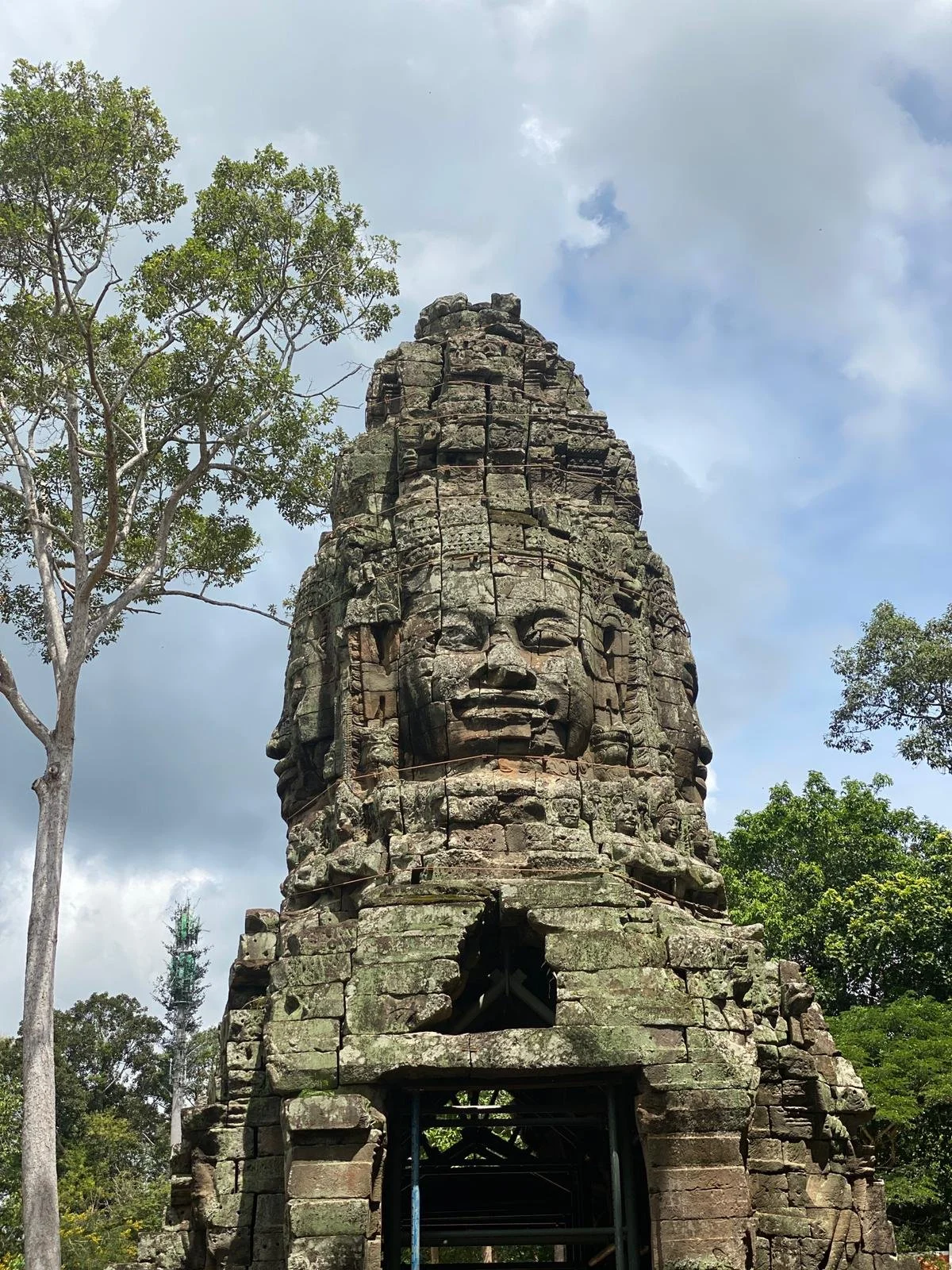
Photo stolen from Mum
In 2010, my family and I went on a short trip to Cambodia where we enjoyed precipitous tuktuk rides down rain-drenched streets and the warm, cheerful hospitality of the locals, which contrasted sharply with the grim sites they brought us to. Our guide at the Killing Fields was a chipper man with a missing arm; he lost it to a bomb explosion when he was very young. The same incident killed his whole family. I don’t know how confronting the scene of the horrific atrocities that was responsible for the pain and loss he suffered every day to make a living didn’t drive him mad, I really don’t.
While I will never forget the Killing Fields and the incredible, resilient man who lived to tell the tale, the magnificent Buddhist temple complex and UNESCO World Heritage site Angkor Wat as undoubtedly the architectural highlight of the trip. My brother and I put aside our sibling rivalry for the moment to gape at the towering stone heaps crowned with grasping strangler trees and the bas-relief sculptures adorning the walls, weaving in and out of the temple’s many pillars ecstatically to admire them at every angle.
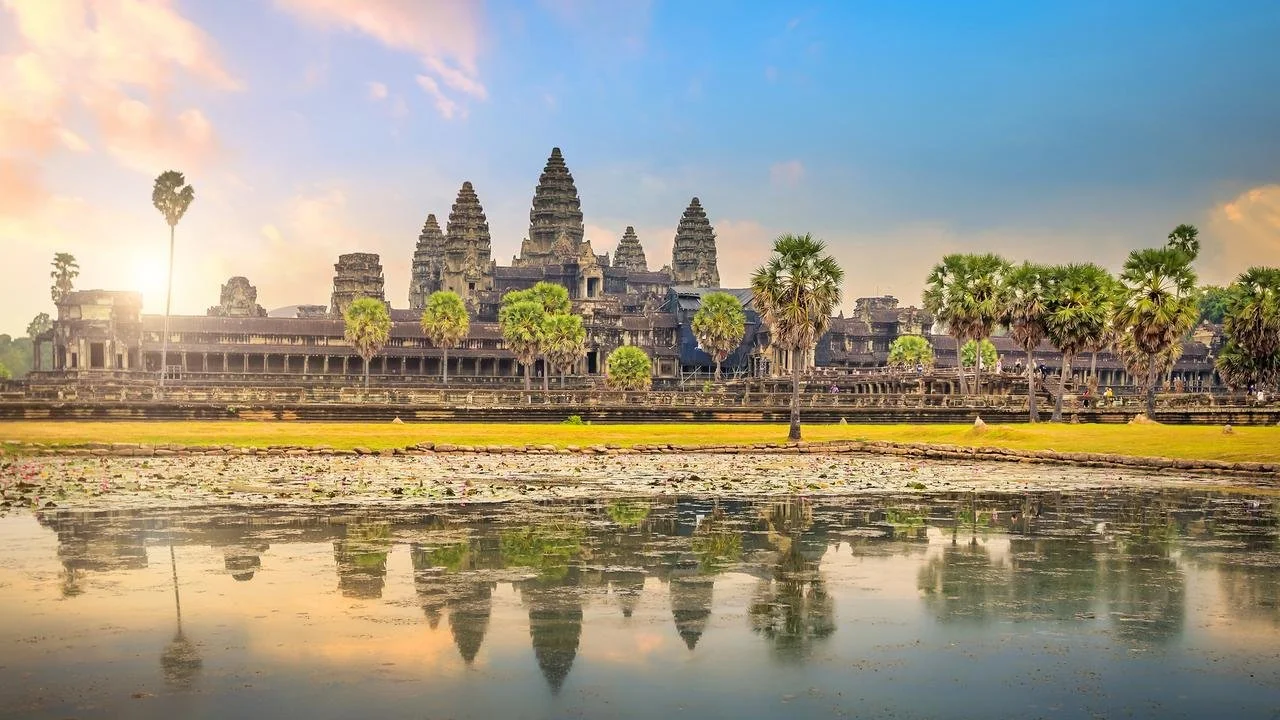
Four years later, I decided to use Angkor Wat as a case study in a school art project which meant doing research and actually finding out what it was that I saw on that trip. Of course we had a tour guide, but at the time I wanted to roam the area freely, drinking in the sights and the feelings of great satisfaction that arose from the tranquil symmetry and harmonious beauty of the place even if I couldn’t put it in words at the time. It might have helped if I had paid attention and caught more than a few snatches of “Khmer architecture”, “devatas” and “Mount Meru”, but my pre-teen resistance to learning was just too strong.
So it wasn’t until high school when I found out that the mesmerizing 49 meters-long stone tableaux I’ve been calling Cosmic Tug-o’-War in my head was an epic depiction called The Churning of the Sea of Milk and regarded as a crowning achievement in Khmer artistry. This work, which runs the length of an entire gallery in the most immensely satisfying repetition of intricately carved figures is one of the 8 major bas-reliefs on the outer walls of the Angkor Wat and part of a larger ensemble of scenes from the Mahabharata. It is the kind of repetition that stops short of tedium and is all the more impressive for it. Nothing shows dedication, care and precision more than the unwavering, close-to-perfect rendering of 180 identical figures (92 asuras and 88 devas) in a straight row on a slab of stone as they tug on a serpent in a symbolic struggle between good and evil. This number is not counting the more-embellished major characters such as Lord Vishnu or Svardhenu, the apsara dancers leaping overhead or the fishes and crocodiles swimming below.
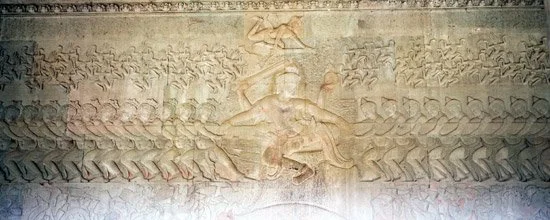
All of this in a symmetry that pulls your eye, from whichever direction you are approaching, to the centre where Lord Vishnu, in the form a turtle under a mountain, directs the action.
This contextual information was completely lost on me when I was there, but the visual mastery was not. Seeing all these epic stories play out around me filled me with energy and caused me to fail to pay attention to what the tour guide was saying. I’m sorry if this made him feel disrespected, but I’d like to think that this was the spell of the place working on me and coming through in the truest way a young, inarticulate and hyperactive kid can express. And that he understood.
Next up: The Hell Museum at Haw Par Villa.