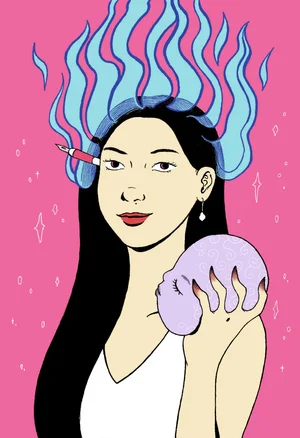
Comics I read so far in 2026
This summer, we lost a legend in comics. Iranian and French author Marjane Satrapi, known for her autobiographical graphic novel Persepolis, passed away in Paris, supposedly of a broken heart. And she’s had her heart broken many, many times.
I took Higher English Lit in IB, or my third year of high school, and we studied Persepolis 1: The Story of a Childhood as part of the course. It was my first time seeing that a comic could be held in the same regard as a written novel, and it was definitely welcome after a very painful semester of dissecting Shakespeare and his play about stupid whiny teenagers who stupidly kill themselves in the end. (Yes, I have no respect for Romeo and Juliet, so you can GTFO with your points about its merits as a satire and commentary on adolescent love because my teachers tried and I still don’t care, studying it almost made me suicidal). I was shown how powerfully evocative a comic could be despite its deceptively simple style, how it can tell a heart-wrenching and emotionally complex story of an entire nation and families ripped apart by a political revolution, as told through the voice of a young girl who lived through it all. As an aspiring illustrator, I was enthralled with the narrative and compositional techniques used in every panel, and I would go on to observe such details in all graphic novels I read after this masterpiece.
But it was Persepolis 2: The Story of a Return that hit me in the gut the way the first book did not.
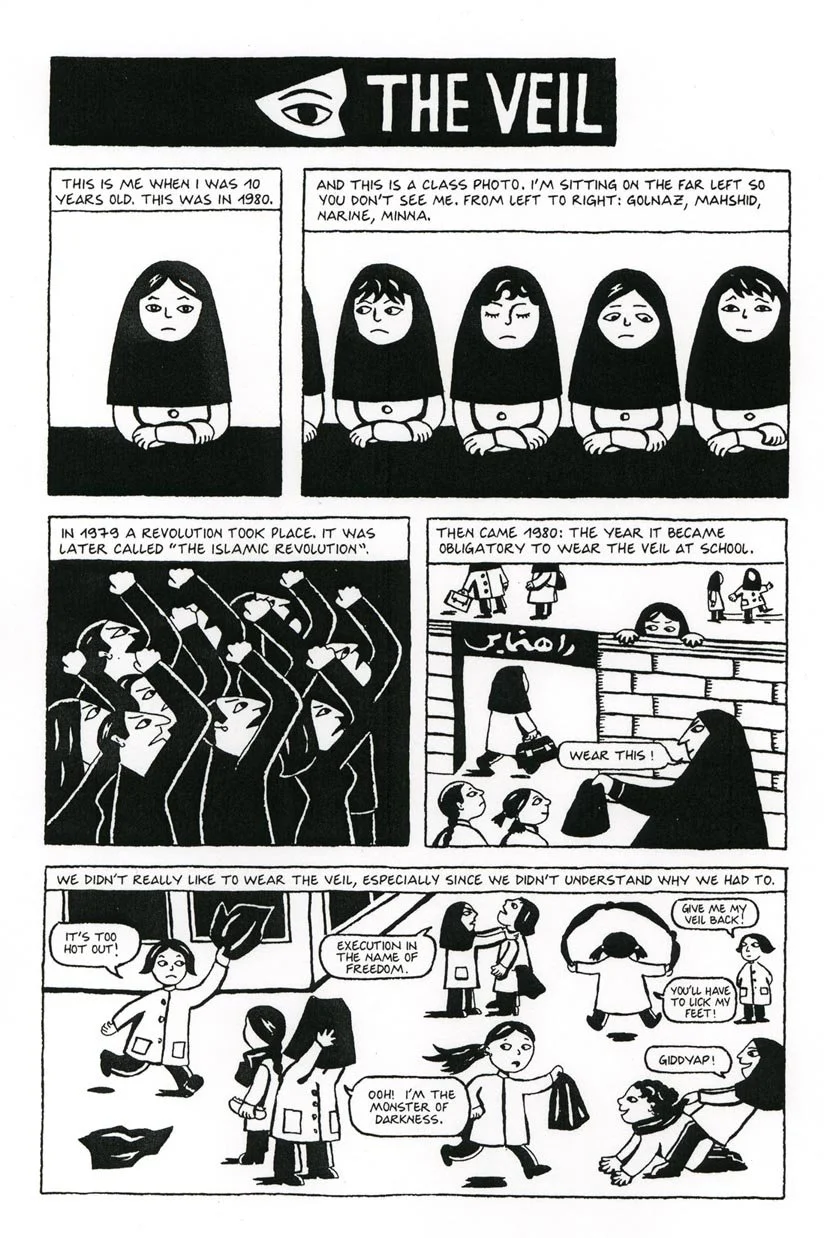
Page from Persepolis: The Story of a Childhood
In The Return, Satrapi is older and so am I, reading this. She’s residing in Europe; I’m in my second or third year of college, pursuing my dreams of being an artist. I have not and most likely will not know what it’s like for my country to be ravaged by war and civil unrest (touch wood), but I am very far away from my family. I am not worried about their safety, but I feel the weight of their expectations that I’m not living up to despite their heavy investment.
So when I get to the part where teenage Satrapi talks about her crippling loneliness in a foreign country where no one understands her and her desire to reunite with her family while also dreading to be seen as a disappointment, I have to put the book down and walk around the bench I was sitting on to silently weep and gulp for air. I was shattered, but also relieved. It was like the book gave me permission to feel my feelings and admit that I might have made a big mistake. That is the power of a book – to make you feel seen and heard in stark clarity. And it wasn’t a thick, fat classic tome that did this for me, but a slim black-and-white comic of cartoons.
It’s been almost 10 years and I still remember that feeling well; also the place I was in, and the view that shimmered in the distance through a veil of hot tears as I tried to calm myself down so I could pick the book up again; it was the quaint little church in my area that I never visited, but always loved to look at from the grassy knoll behind the supermarket near my flat, especially when the sun was setting. Thankfully, I no longer feel the desolation my younger, anxious self did. In fact, I realise now that my life and the decisions I’ve made were not a mistake, and that I don’t owe my parents shit. But we don’t have to get into that today.
We’re here to talk about comics!
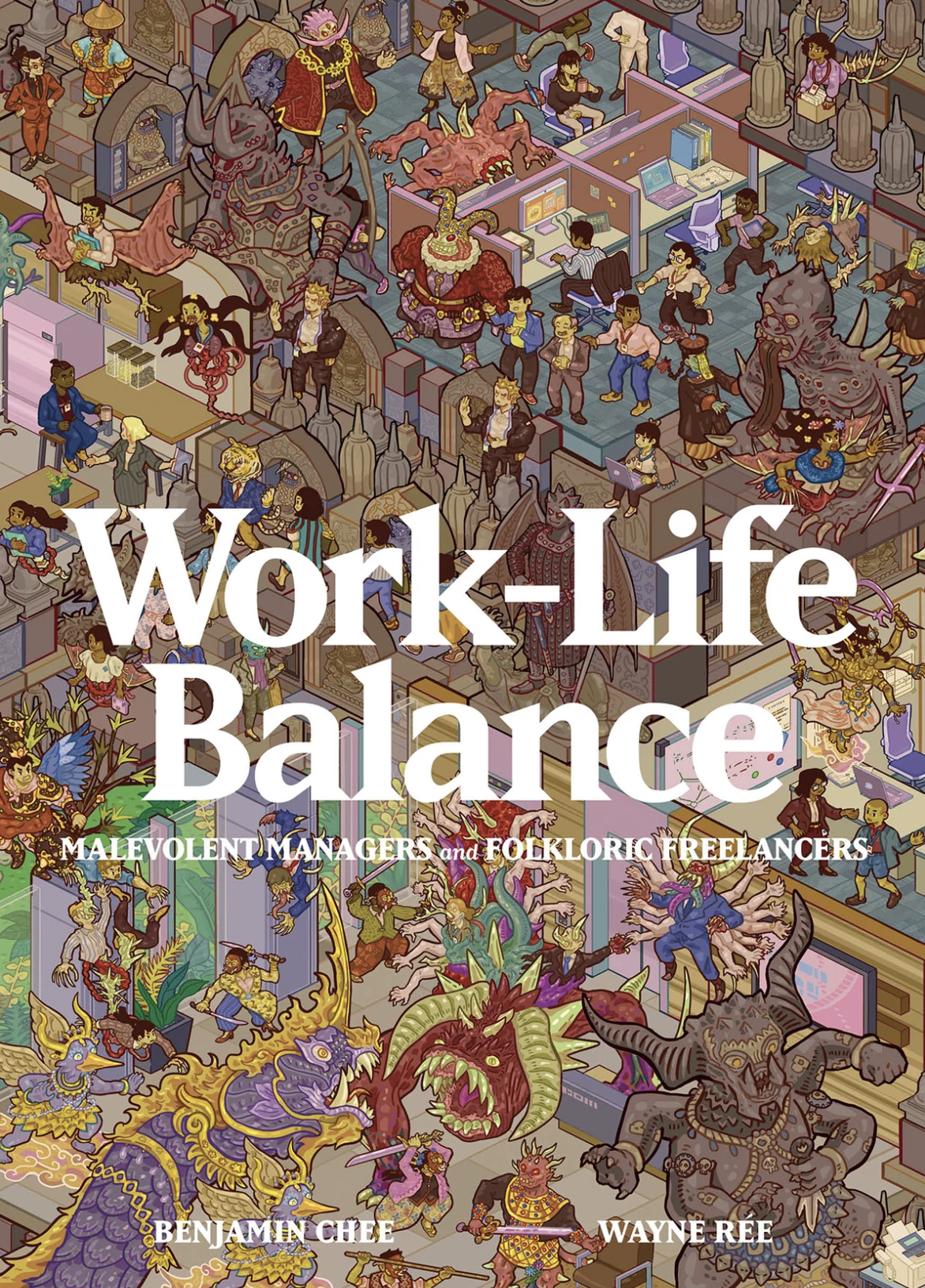
Work-Life Balance by Benjamin Chee and Wayne Ree, published by Epigram.
Description:
When a menacing multinational arrives on our shores, familiar creatures like pontianaks, manananggals, raksasis, and ba jiao guis are forced out of their jobs. Some give in and sign up for mundane corporate life – but others would rather fight than join the broken-spirited hordes of the (desk)bound.
Benjamin Chee’s comics and Wayne Rée’s prose intertwine in this collection to bring you familiar Asian mythology in an even more familiar setting: the realm of dead-end work, glass ceilings, and truly hellish bosses.
Described as a 'comic-prose mash up’, the book began as a short story by Wayne Ree that inspired artist Benjamin Chee to write a comic for. After seeing his work, Ree felt that Chee had “remixed” WLB and return to work on the story, which became the winner of Book of the Year and Best Literary Work at the 2023 Singapore Book Awards. It promises to be “a refreshing take on Southeast Asian myths in a modern-day setting” and “a long-awaited reflection on soul-draining work culture and bosses from hell”, but the prose, which drove the story in the beginning, quickly became overpowered by the comics, which expanded on the world-building with creative concepts where the prose did not.
My experience of the book wasn’t smooth. Despite the author’s note on the format, I was confused if the comics were just to support the text or to add context, because in the beginning it seemed to repeat the events, then later added on the action and dialogue, before taking over completely. Either way, the comics and the prose do not stand on their own, though I enjoy the former far more than the latter and would be interested to see more of Chee’s works in the future. I see Work-Life Balance as a creative collaboration and an exercise in paranormal world-building – which is confirmed by the computer game they designed for this project, Internal Damnation – rather than a story I can sink my teeth into. I played the game as well, and got a good ending on the first try only because I read the book first and learned about the characters and their motivations, which makes the experience of the game too reliant on its source material. The design was freaking cute though! It also gave you a deeper and more granular insight into a day in the life at The Company, which strangely, the book did not.
Fucking incredible cover art though.
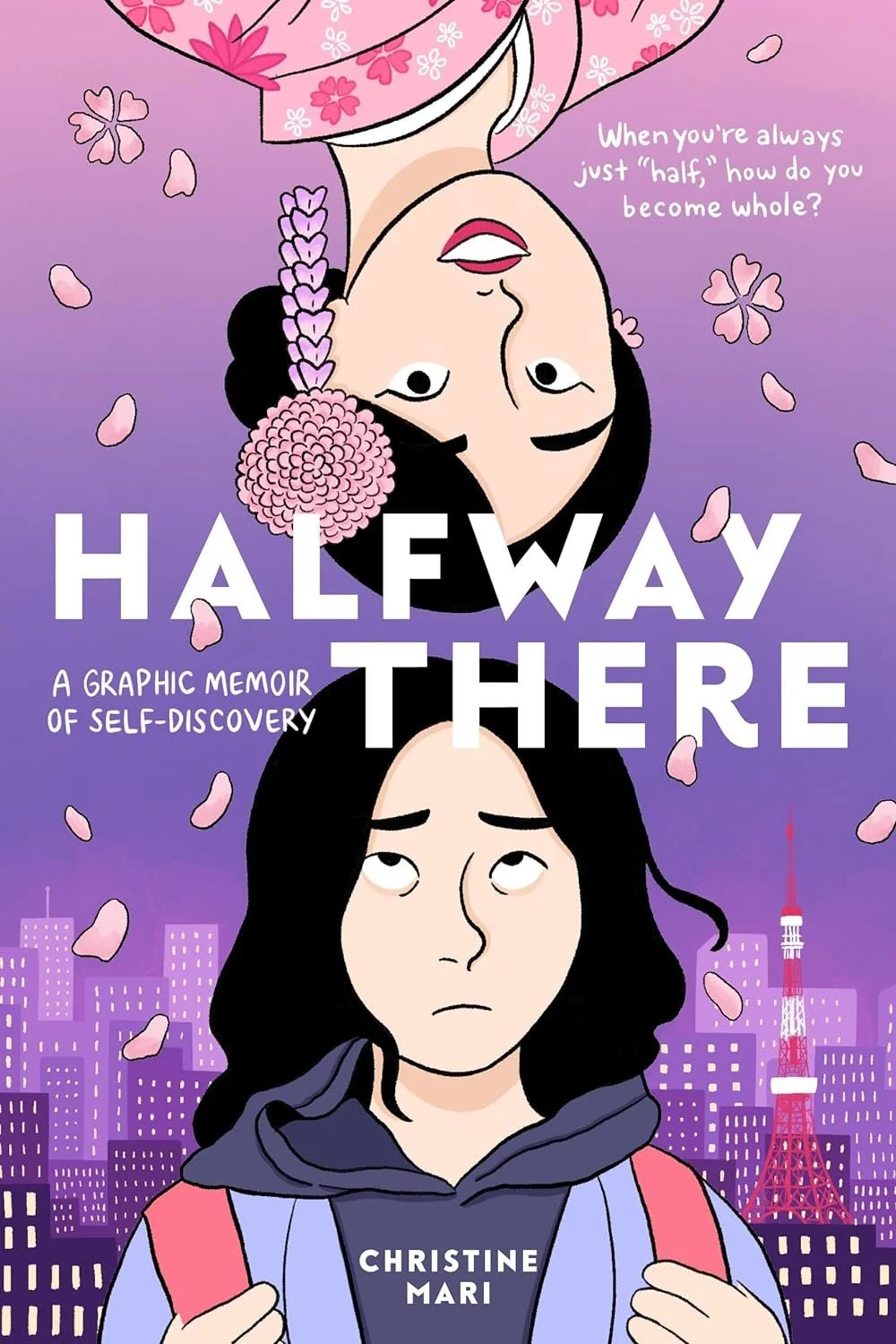
Halfway There by Christine Mari, published by Little Brown Ink.
Description:
A poignant graphic memoir from rising star Christine Mari, following her college year abroad in Japan, as she struggles to reconcile both sides of her mixed-race identity.
Christine has always felt she is just Half American, half Japanese. As a biracial Japanese American who was born in Tokyo but raised in the US, she knows all too well what it’s like to be a part of two different worlds but never feeling as though you belong to either. Now on the brink of adulthood, Christine decides it’s time to return to the place she once called home. So she sets forth on a year abroad in Tokyo, believing that this is where she truly belongs. After years of feeling like an outsider, now she will finally be complete. Except…Tokyo isn’t the answer she thought it would be. Instead of fitting in, Christine finds herself a fish out of water, as being half of two cultures isolates her in ways she'd never imagined. All she can do is try to stay afloat for the rest of the year—still figuring out who she is, what she wants in life, and whether she’ll ever truly be more than halfway there. Christine Mari explores what it means to lose and find yourself in this moving narrative of belonging and home.
I discovered Christine Mari on Instagram, where she still publishes comics about her life, and am currently a free member on her Patreon channel until I make enough money to justify another monthly Internet subscription again. I find all her comics to flow very well and her style to be similar to Satrapi’s in the polished simplicity of her panels. I enjoyed everything she put out, whether it’s a deep dive in her feelings, a storytime about her family and friends, or her more artsy experimentations. But I still wasn’t all that compelled to get her book until I saw this excerpt on Instagram.
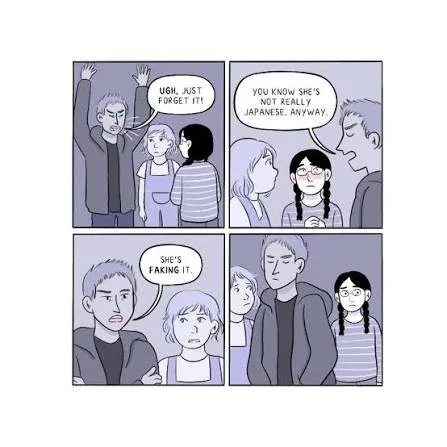
There are many stories out there about being mixed or growing up intercultural; having lived in it myself, I wasn’t in the headspace to read yet another, nor did I think I’ll ever be. But this one hit on a very specific experience: the mixed person’s relationship with language; people doubting your identity because you couldn’t function as their human Rosetta Stone or your accent doesn’t match your face. Language ends up being a huge focus of Christine’s journey of self-discovery and the beginning of her unraveling because of her insecurities surrounding it. Insecurities that are very, very valid. I’m not mixed-race like her, but I can’t tell you how many times my teachers or peers got frustrated when I didn’t know this or that word in Chinese, or how surprised they were that I could speak it at all (a lot of morons out there don’t understand what bilingualism means, apparently).
The hits come at home, too. My aunt will often say something very basic in Mandarin then either ask if I knew what it means or just go ahead and translate it without asking. The word or phrase is usually something you might have already learned in Kindergarten, regardless if you’re a native or second-language speaker. And this woman knows I grew up in China.
Bottom line: I understand all too well what it’s like for everyone around you to decide what your knowledge of a language should be before they even talk to you and just bloody ask. Add to that the later chapters describing Christine’s mental health crisis while studying abroad, this is another comic that made me feel very seen. I appreciate her for being so honest and raw.
Also, the muted colour palette is fantastic.
Description:
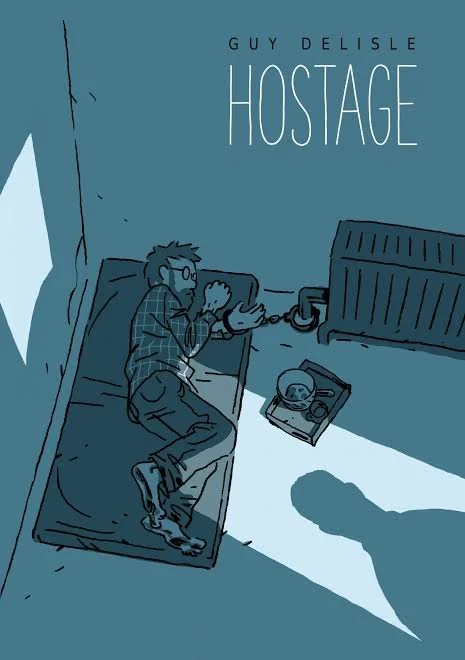
In the middle of the night in 1997, Doctors Without Borders administrator Christophe André was kidnapped by armed men and taken away to an unknown destination in the Caucasus region. For three months, André was kept handcuffed in solitary confinement, with little to survive on and almost no contact with the outside world. Close to twenty years later, award-winning cartoonist Guy Delisle (Pyongyang, Jerusalem, Shenzhen, Burma Chronicles) recounts André's harrowing experience in Hostage, a book that attests to the power of one man's determination in the face of a hopeless situation.
Marking a departure from the author's celebrated first-person travelogues, Delisle tells the story through the perspective of the titular captive, who strives to keep his mind alert as desperation starts to set in. Working in a pared down style with muted colour washes, Delisle conveys the psychological effects of solitary confinement, compelling us to ask ourselves some difficult questions regarding the repercussions of negotiating with kidnappers and what it really means to be free. Thoughtful, intense, and moving, Hostage takes a profound look at what drives our will to survive in the darkest of moments.
Continuing the theme of simple pictures that tell so much - Guy Delisle is a master of this. Hostage is no exception. The comic goes beyond simple: it’s rigid, banal and repetitive, perfectly capturing André’s torture by boredom at the hands of his abductors. The reader should be bored to death, too – I certainly wanted to lose my mind on the poor guy’s behalf – but we’re hooked, on the edge of our seats as we wait for the pin to drop. As a reviewer put its: there should be nothing thrilling about a story of a man chained to the corner of an empty room, with little to no variations in his routine or even the food they bother to serve him once a day - but it is.
Anyway, if you know anything about Delisle and his style, you will know that he is the perfect artist to tell this story and make the mundane interesting. Without saying too much (though this is a non-fiction account, so you can find out what happens to André by looking him up), here is one page showing what time passing looks like when you have no choice but to observe every second of it.
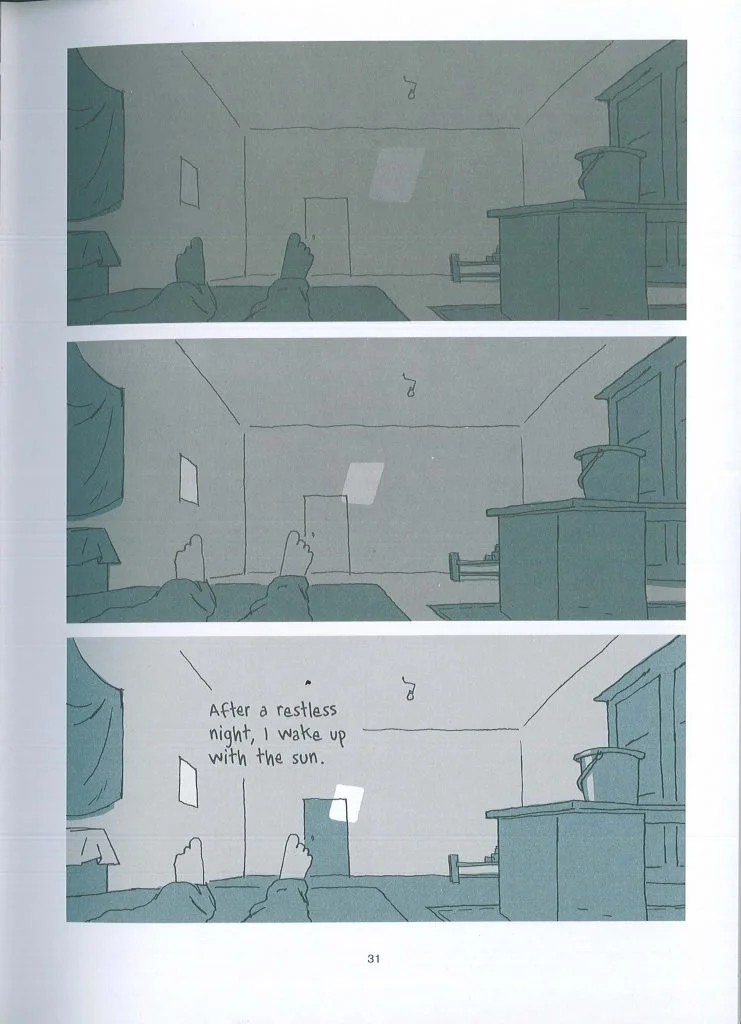
Like I said, I would have lost my goddamn mind. I don’t think I’ve sat in a room long enough to notice the exact moment the light changed since I was a child in the early 2000s. Hats off to Christophe André – who did not let this experience stop him from dedicating himself to humanitarian work – and Guy Delisle for writing his story. The last page of the book is one of the most beautiful pictures I’ve ever seen, the perfect way to end it all, but I won’t share it because I’m not allowed and also, no more spoilers.
Hope to read more comics for the rest of this year.